Find out what we're doing

NEWS & LIVE DATES

Click to continue

New Single – MORE IN SORROW – Available 15th October


SINGLE AVAILABLE 15th October
MORE IN SORROW

(Cadiz Music)

DL | Streaming

Released 15th October 2021

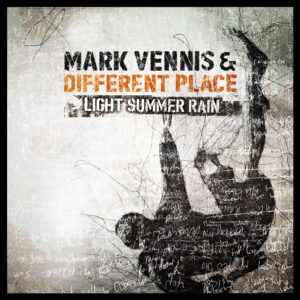
Mark Vennis steps aside from his usual day job of producing films to release a single from his most recent album from November 2020, Fighting On All Fronts. The song, More In Sorrow, is fuelled by what Mark sees are some of the underlying issues of modern Britain with the band’s unique take on reggae shining through.


Most of us may know Mark Vennis through his work in film production, with the 2017 British comedy drama film starring Maxine Peake, Funny Cow, being a notable example. But there is little doubt music plays a huge part in his life, with his production work on the Slits documentary Here To Be Heard and the Don Letts documentary Rebel Dread demonstrating this admirably. But when time allows, he is also known to venture on stage and into the studio to front his own band, Different Place, to extend this passion even further.

The band’s most recent album, Fighting On All Fronts, proved to be a collection of beautifully-crafted songs with infectious melodies, jangly guitars and heartfelt ballads, all shaped by an eclectic mix of influences from rock’n’roll through urban folk to reggae. As the songwriter, Mark focused very much on stories about the underdogs, the oppressed, the forgotten, and the downtrodden. The songs are essentially about the insecurity of modern life and More In Sorrow is one such example which he has lifted from the album as the new single.

More In Sorrow is a poignant and thought-provoking song set behind the band’s unique take on reggae, which is also employed on other songs on the album. The overall sound and solid rhythmic backing draws you right into the subject matter, with Mark’s pointed vocal delivery leaving you in no doubt about the central message behind the song. I will leave it to Mark to explain the background to the narrative as follows:

“The jumping off point for this song was the terrible fire at Grenfell Towers in 2017. To me the tragedy reflects all that is wrong with modern Britain; cost-cutting spivs who get away with it, ordinary people that the authorities and council just don’t care about, a country where the gap is ever widening between the 1% and the rest of us, with the irony being that Grenfell is in one of the richest boroughs in the country. And I don’t think justice has been served for those 72 deaths and the ongoing trauma of the survivors. It is not a song of defeat but a song of defiance.”

Alongside the original album track, the single also comes with three further excellent remixes courtesy of Dennis Bovell, who Mark describes as “the Brit reggae godfather”, including a dub version and an instrumental track.

Also worth noting is that Mark Vennis & Different Place are playing Maxillas Social Club in Notting Hill, London on 16th October 2021 as part of the Clash Against The Right launch event.

You can stream the single here.

You can buy the album, Fighting On All Fronts here.

You can find Mark Vennis & Different Place on Facebook, Twitter, Instagram and their website.

                                                      ~

Review by Ian Corbridge.
You can find more of his writing at his author profile.

LOUDER THAN WAR – Review

Track #4 HOUSE ON THE CORNER OF THE ROAD – Mark Vennis


Some thoughts on the influences on the new album
FIGHTING ON ALL FRONTS song by song, with an
accompanying Spotify play list which is here: 

Songs: Thunder Road
Darkness on the Edge of Town
State Trooper
Downbound Train

So I was going to write a lengthy tome about Bruce Springsteen…but I got bored and it ended up itself. So I stopped. Hence the delay of a new blog.  

The only thing I have to say about Bruce (apart from how much I love him) is that Jeep ad: what the fuck was he thinking? You can’t meet these people half way – as Lou Reed might say the common ground for me is without you. Still I guess he thought he was helping.

Instead of endless words about the Boss, I am going to announce our new single which is a remix of the track House On the Corner of the Road which will be available from April 25 on all platforms. 

Needless to say the influence of Mr Springsteen weighs heavy over many of my songs, but I think House On the Corner of the Road is particularly Springsteen-esque.  

Well the wide open roads are beckoning again, so roll down the window and let the wind blow back your hair, the night is busting open and these two lanes can take us anywhere – well the A3 to London anyway – so enjoy life, enjoy Bruce and enjoy our new single.

More exciting news to come in the next few months…including working with a musical legend.

#markvennis #differentplace #thehouseonthecorneroftheroad #brucespringsteen 


Track #3 CUT ME LOOSE – Mark Vennis


CUT ME LOOSE, SET ME FREE. MAINLY IN BIRMINGHAM

Some thoughts on the influences on the new album
FIGHTING ON ALL FRONTS song by song, with an
accompanying Spotify play list which is here: 

UB40: Food for Thought

Steel Pulse: Handsworth Revolution

Musical Youth: Pass the Dutchie

The Beat: Can’t Get Used to Losing You

Dexys Midnight Runners : Burn It Down

Gregory Isaacs: If I Cant Have You

Patrik Fitzgerald: Set We Free

“Cut Me Loose” the song…

The third track, Cut Me Loose, on our album Fighting on All Fronts is a reggae rock song dealing with the end of a relationship. You know the usual shit – miscommunication, going through the motions, all a bit boring, not supportive.  A big influence on this song was UB40.

Long before Peaky Blinders….

Small Heath, Birmingham late 70’s. it’s raining. Bellows wheeze and puff as ash floats in the golden late afternoon light. Clouds of industrial smoke and flames burst forth from the side of the street. Striding out of the misty smog, in the middle of the road eight young brummies –  all of different origin: Irish, Caribbean, Scottish, Yemani, English truly multi-cultural – are clutching different instruments like they are street fighting men.  It’s UB fucking 40 and they are coming for you. You can hear the saxophone, drenched in reverb, wailing the opening riff to Food For Thought  and Ali Campbell , lead singer and son of a Scottish folk singer,  steps forth, locks you with his steely gaze,, and sings the opening phrase “Ivory Madonna, waiting for the manna, to come in from the west” in a laid back but bitter attack on the West’s hypocrisy in their version of a Christmas song.

UB40 ‘s debut album SIGNING OFF was released on 29 August 1980 and we can thank Chrissie Hynde for giving them their first leg up (support slot on a Pretenders tour in 79).

Signing Off is a pitch perfect evocation of early 80’s Britain  – the dole, the dreariness and the weariness, still with a WW2 hangover,  the whole beige greasy joe caff feel – and one of the finest albums from that period (or any period). Fiery and militant, tuneful and dubby, like the Specials did with ska, they took reggae and rinsed it through a Brit/punky sensibility.

Completely unique they never bettered it.

Apparently the 80s were all about greed being good, power dressing, big hair, imperial nostalgia, and  selfish asses. Not for me or my friends. It was in fact a glorious decade of Brit refusnik pop, from the The Jam to the Specials to the Smiths, from Frankie Goes To Hollywood to Culture Club and Soft Cell and UB40, who at the dawn of the decade made an indelible mark.

And if you were lucky enough to get the double album re-release in 1985 including Madam Medusa and The Earth Dies Screaming with dub versions then fuck me you’ve hit the jackpot. 

A lot people were in the  doldrums with Maggie on the throne waging war against the young (as per usual) and the working class (as per usual) and black people (as per usual) and anyone a bit different (oh, as per usual). Does sound familiar doesn’t it? The hippies had all become fat cats (Hello Richard Branson) and the cops were cracking our heads (Miners strike, Wapping, Poll tax demo). UB40 epitomise the early part of that era. Formed out of the urban cauldron of multi cultural Britain (like the Specials and other two tone bands), in this case Birmingham, they were anti-establishment and anti-fascist. And the music –  reverb heavy, a little downbeat, sharp lyrics and a great melodic sax player – still has that passion and immediacy running through it.  

Of course, the band went on to become one of the biggest reggae acts of all time, through a combination of playing covers in a reggae style and commercially astute song writing, pretty much leaving that initial vibe of their first two albums behind.  They still chug along now in two different versions, as they fell out really badly, but in between 1979 and 1981 they were at the top of their game.

The other really great reggae act to come out of Birmingham was Steel Pulse. A Rasta band inspired by Bob Marley (who isn’t) they were signed to Island records, made common cause with the punks and Rock Against Racism, and released Handsworth Revolution, a truly revolutionary record in 78. Containing 8 songs, it was really melodic, intricately sung and played with strident up front and political lyrics. More song orientated and less dance based than a lot of reggae (Lee Perry re-used many of the rhythms and bass lines over and over, as did many reggae producers) it is militant and righteous and really musical. During the course of 1981 Handsworth (like Brixton and Toxteth) erupted in a three day long riot because of heavy handed policing and a potential National Front march. Bubbling beneath the rioting, as usual, was large scale economic depravation and racial discrimination.  As the MLK rhetorical flourish goes – riots are the language of the people who are not heard. Steel Pulse are one of the bands that gave them a voice and Handsworth Revolution is a heady brew, and I don’t think they made a better album.

And let us not forget the fantastic Musical Youth, pint sized Brummies, and their classic hit PASS THE DUTCHIE, which was a cover of a song called Pass the Kutchie (which I think was about passing a pot around that contained cannabis). The lyrics were changed so that it was about passing a stone pot of food (a Dutchie in Jamaica) and became a song about hunger. What a great song, number one with a bullet (as they use to say) and a really young black British band performing a reggae song in front of the House of Commons in a video by the great Don Letts. Put that in your pipe and smoke it Maggie.

Let’s stay in Birmingham.

The album Just Can’t Stop It by the Beat is a pared to the bone, sharp, political and youthful record. The Beat were a ska band who mixed in Latin and African elements into the music, a soulful singer in Dave Wakeling and a great toaster in Ranking Roger. Where the Specials started the two tone ball rolling (and they were from neighbouring Coventry, not Brummies) The Beat had a unique sound all to themselves. There are many standout moments on the album but particularly the hit Can’t Get Used to Losing You, made famous initially as a lounge crooning classic by Andy Williams, is made into a slinky dance ska song that is not over fussy and kind of languid while being alert.  I think it was the bands biggest hit.

Onward into the deep waters of Birmingham’s (well Wolverhampton – let’s not get picky) musical history and Birmingham’s cultural annus mirabilis (that’s Latin) of 1980 and Dexy’s Midnight Runners.  Straight out of the Midlands via Ireland, Dexy’s took their inspiration, at least initially, not from the influence of ska and reggae but from soul music. And yes, soul music filtered through punk rock (I think there is a theme here). Dexys were all about confrontation. For god’s sake burn it down.  The cover of Searching for the Young Soul Rebels, released in July 1980, has a catholic boy in Northern Ireland being forced to move because of the “troubles”. Kevin Rowland, the legendary kingpin of the band, is famous for his apparent abrasiveness, stubbornness, a “won’t suffer fools lightly” attitude, chippiness, perfectionism, his way or the highway pal, general single minded vision of what his music should sound like. I’ve no idea whether he is like this or not (met him once and he seemed lovely) but what he achieved over 40 years with a relatively minimal recording output is remarkable. Searching for the Young Soul Rebels is a passionate, angry, sometimes bitter, life enhancing, rebellious celebration of being an outsider and of being young and working class in Thatcher’s Britain. But not just a snotty nosed outsider, a really articulate and arrogant one placing himself into the greats of Irish literary lineage (check the lyrics to Burn it Down) like a punk Van Morrison. And Rowland sings like a soul singer, but on the edge of a nervous breakdown. By the time Too Rye Aye came round he had mellowed (a bit).

One of my favourite stories about Rowland and the band is when they stole the master tapes for the album Young Soul Rebels because they thought EMI should pay them a better royalty rate. They won, EMI relented and of course the album was a massive hit (helped by Geno’s number 1 success as a single).

The original line-up burned brightly and then split – did I mention that Rowland had a rep for being a control freak? – and then Rowland brushed himself off and made a Celtic soul record (very influenced by Van M and his Irish mystical soul brother routine) that reached massive commercial heights (Come on Eileen) in the UK and US. And after Don’t Stand Me Down (another great record) flopped in 1985 he went through mental issues and drug problems, emerged with a solo record where he was dressed in lingerie (tres chic Kev), got bottled at Reading Festival and then reformed the band and still had it in him to title a record at 60 called “One Day I’m Gonna Soar” (also great), Kevin Rowland – a true idiosyncratic musical genius. He followed his vision to wherever it took him, through commercial success, to rock bottom excess, and back again. When they make the film of his life, I want to produce it.

All those words – maverick, genius, visionary – are overused but Kevin Rowland is all three of them. Isn’t it time he/Dexy’s made another album?

Just on a side note here Mick Talbot played with Dexy’s, then was a founder with Paul Weller, of The Style Council then came back to Dexys for One Day I’m Gonna Soar. He needs to write an autobiography.

I’m not sure where Dexy’s influence is with Cut Me Loose, but I’m sure it’s in there somewhere.

With the lyrics of this song, I tried to paint a picture of a relationship fraying in the harsh light and continuous hustle of London. In my mind it always had a reggae swing to it, always a relative of a Gregory Isaacs song, albeit with a much less mellifluous and melancholic vocalist. I was aiming for the same ballpark as Gregory – didn’t quite make it.  Gregory Isaacs had one of those voices – worn, sad, emotional – that you might associate with a great soul singer. Well he was a great soul singer. He sang about matters of the heart mostly, with a number of pretty good forays into more righteous material, but he is famous for being a lover’s rock guy. The Cool Ruler. The Lonely Lover. The song, If I Can’t Have You, spare, minimal with bass and drums from a top of their game Sly Dunbar and Robbie Shakespeare, is from one of my favorite albums of his called More Gregory from 1981, just before the huge success of Night Nurse (that fucking advert) when he signed to Island. Isaacs spent time in jail for drug offences and tragically died far too young at 59 in 2010. Very sad – he is one of the greats.

And finally, a last word from a long lost punk rocker name of Patrik Fitzgerald, a proto Billy Bragg, who sang about romance, heartache, politics and love of reggae with just a guitar and a punky off key slightly sarky and snarky delivery. Never became a big star, should have, obviously. Always brings a smile to my face (Work, rest, play, REGGAE!) with his angry, funny and human lyrics. The song Set We Free was released as part of an EP “Safety Pin Stuck in My Heart” (for you, for you) released in 77.

Next time Bruce Springsteen is in the headlights – the eternal conundrum at the heart of the contradiction that is the relationship between art and commerce. Or something.

Over and out.

#UB40 #steelpulse #Handsworthrevolution #thebeat #musicalyouth #kevinrowland #dexysmidnightrunners  #Gregoryisaacs #PatrikFitzgerald #markvennis #differentplace #cutmeloose


Track#2 WITHOUT YOU I JUST WASTE AWAY – Mark Vennis


Some thoughts on the influences on the new album
FIGHTING ON ALL FRONTS song by song, with an
accompanying Spotify play list which is here: 

“Waste Away” the song…

The track Waste Away is my attempt at a classic three chord garage rock track. The influences stretch back to the 60s and those great chroniclers of English life The Kinks, particularly the end of empire classic Victoria. Ray Davies had a knack of writing lyrics that were the right side of sarcastic, but that still skewered his target, usually life in class based England, with a sharpness probably only ever equalled by Paul Weller 15 years later. And while my track Waste Away isn’t about the British Empire, more of an askance look at life in the city, Ray Davies’ lyrics and melody are certainly somewhere in the mix of this song….

Moving up the years to the desolate mid-seventies that pre-punk, post sixties slump where the bands had become, by and large, bloated and patronising and completely dislocated from their fans, where only Bowie and a few other cool dudes were there to help Brit youth through the shit, along came a band who brought everything back to basics. Dr Feelgood looked like a bunch of East End gangsters and had the most in your face frontline since the Who in the mid-sixties. Wilko Johnson and Lee Brilleaux played like their life depended on it, with attitude and aggression, short and snappy and of course they pre-figured the punks a few years later. While the lyrics were pretty much standard my baby left me blues type of stuff the way the music, and especially the guitar, was played was the great thing. Wilko played the guitar like no one else.  Without a pick! Short and to the point solos! No fancy effects! No showing off`! He wielded his telecaster like a weapon. Eyes bugging, duck walking, giant splits while Lee Brilleaux sang and played the harp like his life depended on it. (When I first tried to play with out a pick it just fucking hurt. How does he do it?). But those staccato riffs and the tough little blues curlicues still rip it up to this day…and his influence is huge particularly on Joe Strummer and Andy Gill (Gang of Four) and Bill Carter, who was the creative force behind one of the best bands of the 80’s, the Screaming Blue Messiahs.  

In my mind there isn’t a great leap between the Feelgoods and Lou Reed and the Velvet Underground, other may disagree… The Velvet Underground, like the Feelgoods in the 70’s, were generational refusniks back in the 60s. Not quite as rough and tough, they essentially played anti-hippie music. They were not into peace and love. Their music was split between noisy atonal discordant stuff, (sometimes) highly melodic garage rock and blissed out soft rock.  John Cale was the master of the former and Lou Reed the master of the two latter forms. Sometimes the sides came together in an amazing way as with Venus In Furs (later used for a Dunlop tyre ad, oh fucking hell) an ode to S&M and leather and sex and drugs. More often than not, they did not. They were, like a lot of great bands, a reflection of part of the city that formed them, New York, and specifically the New York art scene under the influence of Andy Warhol. It was he that designed the zippable banana on the cover of the first album. Outrage amongst our moral guardians! Except it only sold about 2 copies, so they will not be corrupting the youth of America any time soon with their drugs and banana knob references and cross dressing and pop art shit.  At the time they were not commercially successful – they really were swimming against the prevailing hippie, blues rock jam – but it is said that everyone who listened to them formed a band.  Can’t remember who said that, but someone very incisive. 

One of the things about them, of course, is that Lou Reed is probably one of the best lyricists ever and he had a tremendous eye for the detail of his scene – the cross dressers, the parties, the pretentious arty farties – and able to view his own habits and shortcomings with his droll nonsinging singing voice, which sounded slightly sneery and sarcastic, whilst maintaining an empathy for the outsider, the underdog, the downtrodden. Lou never punched down. He was always one of us, not one of them. Too cool not just for school but pretty much everything, the king of all cynical yet soft hearted writers, if he hadn’t been a rock star, and born a few decades earlier he would probably have been a hardboiled noir author writing novels about compromised men and good people forced to do bad things or a Hollywood scriptwriter writing Humphrey Bogart films. So I could put on the turntable Sweet Jane, or Satellite of Love or Waiting for the Man but I’m actually going to fast forward 20 years to the 80s and the release of Lou’s finest and most complete post VU work the album New York. Better than Transformer and Berlin? Yep fraid so.

This is the album that Lou takes a look around the city he loves and decides to tell us how much he doesn’t like what it has become. A country founded on immigrants, now has forsaken them and the famous American Dream (more like a nightmare now), and the denizens of its premier city are rolling around in the gutter smoking crack, trying to get by while the countries rulers & movie stars drive around in limos and destroy the planet.  The statue of bigotry indeed.  What has my city become he asks in song after song and therefore what has America become. It ain’t pretty. Poverty, hypocrisy, addiction and the American way of life are all chewed over and spat out by some of Lou’s sharpest and angriest writing. His gaze is merciless and (usually) on target (still unsure why he had to have such a comprehensive pop at Jesse Jackson) and even Trump and Giuliani make appearances.  And its Lou reduced to his essence – a garage guitar sound, the songs over three or four chords, and that voice and those lyrics.  The album packs a powerful punch.

Listen to New York by Lou Reed and then read Lush Life by Richard Price. 

Check LOU REED: DIRTY BLVD on the playlist.


Lush Life is a superbly written crime novel from the late Noughties and probably Price’s masterpiece. Price is the author who wrote Clockers and a bunch of other brilliant novels (Samaritan, the Wanderers, Freedomland) and spent time writing for the rightly acclaimed TV show The Wire. 

Lush Life is more than a crime novel – it is a densely written cross cut of New York society, in particular the immigrants in the lower east side. Its ordinary heroes are all compromised, weary, a bit shabby. But it has a humanity to it not always found in American crime fiction – its prose is not tense terse Ellroy edge of a nervous breakdown machismo or the stone cold nihilism of Robert Stone’s lost Americans – it’s more humane. Maybe not as angry as Lou, maybe its tone is more sorrowful. If it was music it would be Miles’ lonely trumpet to Lou’s angry rock.

Gonna remain in the 80s for a very Brit band called The Godfathers who were formed by the Coyne brothers, Peter singer and Chris bass player. Probably a bit too obsessed with both East End and US gangsters (for a while they had a tradition of having a gig every year around the 14th Feb called the St Valentine’s Day Massacre) but no problem as they made a sound that welded 1965 era Who with the Feelgoods and the punks. With a jaundiced eye verging on nihilism their signature song was Birth School Work Death, a snappy ditty about the total fucking uselessness of life, which we play live sometimes. They were a major label signing (CBS) but were too aggressive and gnarly to become a stadium band in the UK (I think every A&R man in the late 80s was searching for the new U2) and too British to become something in the USA. After a run of three tremendous albums (BSWD, More Songs about Love & Hate, Unreal World) they left CBS and slightly went into the indie wilderness although their latest album (a Big Bad Beautiful Noise) is fantastic.  This track sums up their slightly grumpy worldview, low slung guitars, great chorus, great rock n roll.

The Godfathers are none too distant cousins of an American post-punk roots band called the Blasters, and like that band were formed by a pair of brothers, these ones called Dave and Phil Alvin. The Blasters (maybe a bit softer hearted) played with attitude that channelled the old blues guys through a punky filter.  This one song, Just Another Sunday is off a terrific album of theirs called Hard Line (from 85) and is a co-write between Dave Alvin and John Doe of X. Like the Godfathers in the UK, the Blasters never got their due. Dirty guitars, gritty vocals, a terrific sound mixed in with rootsy sometimes Tex Mex sounding numbers. Dave Alvin later went on to play with LA Punks X and then forged a career making one great alt-country roots album after another – story based songs about the down at heel and unlucky, doomed love affairs in cheap motels, victims of a system that is not in their control. Sounds familiar. 

Lyrical soup:

“Another existential cop”– why is it that cops are the only ones, according to television, who are going through some form of crisis about where they are going in life?  Doesn’t anybody else get a (cultural) look in? What about train drivers? nurses? teachers? Someone apart from a fucking copper. AGAIN. Sad yet brilliant Scandi detectives. Sad yet brilliant American Detectives. Sad yet brilliant detectives played by Idris Elba. JESUS CHRIST ENOUGH.

And who the fuck is that vicar and his burgers and fries? Get me some redemption not ketchup, motherfucker.

and why is Night of the Living Dead shot in black and white? Cos that is cooler? It’s all Romero could afford in 68 and his creative rationale was that it made it more like a doc and grittier. So yes, in fact, cooler.

Final song Smash it Up (Parts 1 & 2) by the Damned. A classic and another sour yet funny  nihilistic punk rock promise by one of the original punk bands. And of course its parts 1 & 2 – because I certainly wanted to know that Capt Sensible can really play guitar and is every bit the equal of those prog rock nitwits and two fingers to those silly old idiots who went on and on about punk not being proper music. 

As they say, and I love a good cliché, three chords and the truth baby.

Sayonara til the next time.

Spotify playlist #1: These four songs plus some other great tracks.

GO FOLLOW US ON SPOTIFY

#thekinks #velvetunderground #loureed #lushlife #richardprice #newyork #thegodfathers #theblasters #davealvin #thedamned #smashitup

Fighting on all Fronts – Mark Vennis


Some thoughts on the influences on the new album
FIGHTING ON ALL FRONTS song by song, with an
accompanying Spotify play list which is here: 

“Fighting on all fronts” the song…

I’m going to be writing about music, books, films and maybe other stuff that influenced our album Fighting on All Fronts. Hopefully I can cast some light on the journey it took to get to these songs. Maybe open some doors, maybe reignite some passion for music, maybe highlight some old memories. 

At the moment we need music more than ever. To bring us together; to salve our worries; to make us think;  to soundtrack  our lives; to feed, maybe release, some anger; to get us dancing, to get us back in touch with each other and ourselves; to make us feel.

Music has been a defining force in my life  – from the moment my older brother played London Calling, it has always been there as a constant source of support and inspiration.  I’ve listened and loved many different genres of music but punk was the jumping off point for me. The DIY attitude and the open mindedness and rebelliousness, the be true to yourself deal of it, the anti- ignorant, non judgemental and creative vibe.   Punk rock, mod rock, reggae, sixties rock, garage rock, the blues, dub, hip hop, soul, country, folk, jazz, calypso, ska, and the various different mash ups of all of them….. I  love them all, some more than others, but all have something to say to me. 

Like a photograph music can bring a rush of memories back, and my own collection of music sometimes acts like a photo album. Musical snapshots going back…  that remind me of friends, places, cities, work colleagues, holiday’s, and kids. I guess it is like that for loads of people.

It’s literally the soundtrack to my life. Whenever I have a spare moment I put music on. Whenever I’m in the car I put music on. In fact wherever I can I put music on.  Like an addict I consume it as much as possible. I think about chords, melodies, lyrics all the time – I fall asleep thinking about new songs of my own, of other peoples songs, and sometimes wake up doing the same. It is an all pervading love, sometimes much to the chagrin of the people closest to me. It has never let me down, never betrayed me, always supported me. I am an obsessive, a music junkie. It expresses every human emotion and feeling in a beautiful language that I am no way near to mastering.

Given all that there doesn’t seem any point in closing your mind to any music…true you may have to work harder at some tunes than others, but they can be the most worthwhile. And I think that is an important rule to live your life by  – keep an open mind!

The key thing to all of it I think is the music has to have some integrity. It can’t be cynical. It cant be done just because you think you are going to be famous or rich.  Music is an unfiltered direct connection to your heart. And sometimes it is a direct connection to your head. And sometimes your feet. And if it makes that connection….why refuse it. 

Unlike films, which is a collaborative and commercial artform, mediated by actors, money, script writers, directors, producers, studio heads, acquisition execs the list goes on  – all putting their creative touches to it…if you can string some chords together with some phrases then you can take your acoustic guitar and express yourself. Everyone has it in them I think. 

Hopefully this blog shines a light on the process and maybe make you think, maybe make you move.  

It may get a little discursive at times, but there is no overarching narrative to this.

Your own songs, I often think, are like your children. You love them all, and have different relationships with each of them, but you see them in a certain light, which is not how other people may see them.

You work hard on the lyrics and hard on the chords and melody (sometimes years!) and then  give it  to the band and to Duncan my producer and then it comes back to you in a slightly different (oh I hadn’t of thought of that!) way and then the songs have grown up and you let them out into the world …and then its all out  of your control and the songs get to mean different things to different people.              

Nothing is a straight line, everything goes into a big old melting pot.

The song Fighting on All Fronts was originally a full throttle Clash style rocker, but over  time it became this kind of ska number whose music uplifts (I hope) and the lyrics make  you think.

I was introduced to reggae and ska via The Clash, particularly the album Sandinista, which was the first Clash album I got and one of the really fantastic songs from that album (and it is an album  with many great songs on)  is  One More Time which, I think, Mikey Dread, the great reggae DJ and toaster had a big hand it, and it has a brilliant righteous lyric by Joe Strummer and a spanking bass line by Paul Simonon. On the Spotify playlist I have put the dub version of the song on as well …which is also terrific. I’m really into dub and remix versions of songs – more in another blog on that. Sandinista is a triple album – weighty –  and what I never really understood was why they didn’t release a double album with a third disc of dub versions on it. They seemed to want to stick it to CBS (fair enough) and sold it for the price of a single album – which meant they made very little money initially from the sales. It is probably the most controversial of all their albums, splitting their fans – and the critics – down the middle.  But it is the sound of a band expanding their horizons – from the melancholy lonely late night vibe (Tom Waits territory) of Broadway to the dub scapes of If Music Could Talk and The Crooked Beat and the white boy rap (and humour) of The Magnificent Seven. The genre hopping is central to the music that I make, and the lyrics, I hope, reflect that world view.  It is an album that still inspires today. And its forty years old this month.

Everyone is fighting on all fronts right? Even the stinking rich have bad days (but the money helps right?). It’s the kids, the hangover, the boss, the job, the trains, the fucking rain, your lovelife, the car, the money (or lack of), the government, the pandemic, the forest fires and burning planet , – the list is endless. This song is about that – that jittery, don’t know where to go for help, oh no what’s next feeling. One of the dynamics of the song is that while the lyrics are kind of downbeat, the music is upbeat – and it is that optimism of the will and pessimism of the intellect almost contradictory feeling that I’m trying to capture. Life aint simple like that and and fuck it its got a great ska groove that will get you moving.

As an aside the line “Got stopped by the cops, you’re not from round here are you sir” from the Fighting on All Fronts song actually did happen when a none too bright copper pulled me over late at night in my car and  asked me my name…when I told him, obviously hearing the word Vennis, a very dim lightbulb went off in his head and he said that exact phrase “you’re not from round here are you sir” in a snarky tone.  He and his mate then proceeded to search the car top to tail….just so you know nothing was found…

Next crucial song is RAT RACE by the Specials.

I use to see Jerry Dammers when I lived in Clapham – he must have been living in the area – but never had the chutzpah to go up to him and say what an influence he had been on me. Politically and musically Jerry was a hero. A man with eclectic and wide taste, who like Joe Strummer, wrote great astute political lyrics with edge (he wrote Ghost Town!) and played such an influential role with music and politics in the 80’s because of  the song Free Nelson Mandela. But the Specials weren’t just Jerry Dammers – they had other great songwriters amongst them, and this song, Rat Race, is a fantastic rant about rich students written (I think) by Roddy Radiation. It is also 40 years old and as fresh as a daisy.

What is so great about the Specials is that they were political by the very nature of being a multi racial band, playing a form of music originally from Jamaica filtered through a punk lense and with a  punk attitude. They showed that just by being together on stage that we had more in common with each other than with the people that ruled us who always want to divide us. And of course at that time the National Front was on the rise – check out the film White Riot for more detail on that period, its about the rise of Rock against Racism.  What is a sad judgement on the past four decades  is how little distance we have come since then. 

 And by the way the newish Specials album is really really good as well.

So in this song Fighting on All Fronts the protagonist goes from his mid life crisis to money worries and being hassled by the cops to angrily pointing the finger at the 1% as he stares at the boats in the harbour.  He is saying this is the dream but the reality is nothing like it – all they do is fuck you over. Who are “they” you ask – well I will tell you who some of “they” are – the corporate bosses, the government, the smallminded, the money before people type of person who sound oh so reasonable, every squirrelly motherfucker making life harder for you, smiling while lying, dividing while profiting. That’s them. But you knew that. 

So that’s that sorted.

The way I try and write lyrics is as a form of short story or short film writing.  To set the scene, to have some detail, to have a bit of drama, to have a payoff. 

I work in the film industry and films are almost as important to me as music…and one of those films that exerted a magical pull was The Harder they Come.

The Harder They Come is a great Jamaican film from 1972 starring Jimmy Cliff as a Kingston gangster who wants to make it in the music biz, gets ripped off, shoots some abusive cops and ends up a folk hero. It is one of the most influential Jamaican films, and also boasts one of the finest soundtracks ever released….one of the songs, Johnny Too Bad,  is by a band called the Slickers and tells the tale of a rude boy who just kills for no reason apart from being “too bad”. But the payoff for being like he is is that he has no one or nowhere to run to. There is no glorification of this bad man, nor any judgement just an edge of sadness of how alone he is. In beautifully succinct lyrics sung in a soulful voice, against a reggae ska beat, we get a whole movie in one song….John Martyn, the folk singer who took no shit, covered it later in his career, the character clearly appealing to him and  not just the name. Johnny your too bad…

Now what’s a guy like the one in my song gonna be listening to?  I think the most appropriate soundtrack to a mid life fighting on all fronts and doing stupid irresponsible shit is the sound of Shaun Ryder at his most funny, profane, and articulate with Black Grape. Shaun Ryder is a brilliant lyricist and that’s it for this blog…..

Listen to: Reverend Black Grape by Black Grape. 

Next time I will giving some thoughts on track number 2 on the album, Waste Away.

Spotify playlist #1: These four songs plus some other great tracks.

GO FOLLOW US ON SPOTIFY

#fightingonallfronts #sandinista #thespecials #theclash #markvennis #differentplace

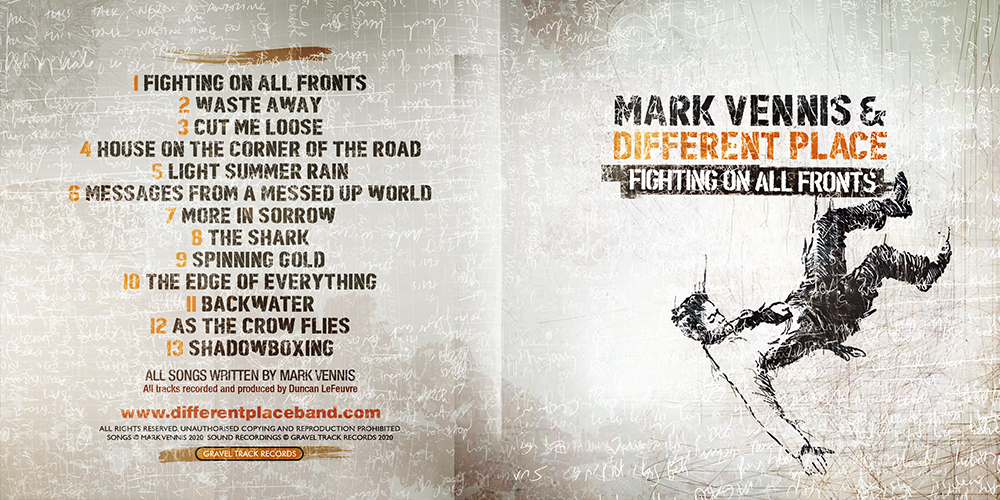
New album FIGHTING ON ALL FRONTS released.

These songs, all written by Mark Vennis, are about the underdogs, the oppressed, the forgotten, the downtrodden and down at heel, These are the people you don’t read about: the loved, the lost, the sinking, the drowning, the burning. ‘Fighting On All Fronts’ is an album about the insecurity of modern life, tales from the end of the world, and that age-old battle with yourself. There is light and shade and there are good times and bad.

Hailing from South of Guildford and North of Portsmouth Mark Vennis & Different Place write and play songs with attitude.

“We are just trying to make sense of it all the only way we know how – through our songs.”

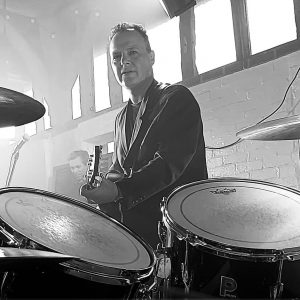
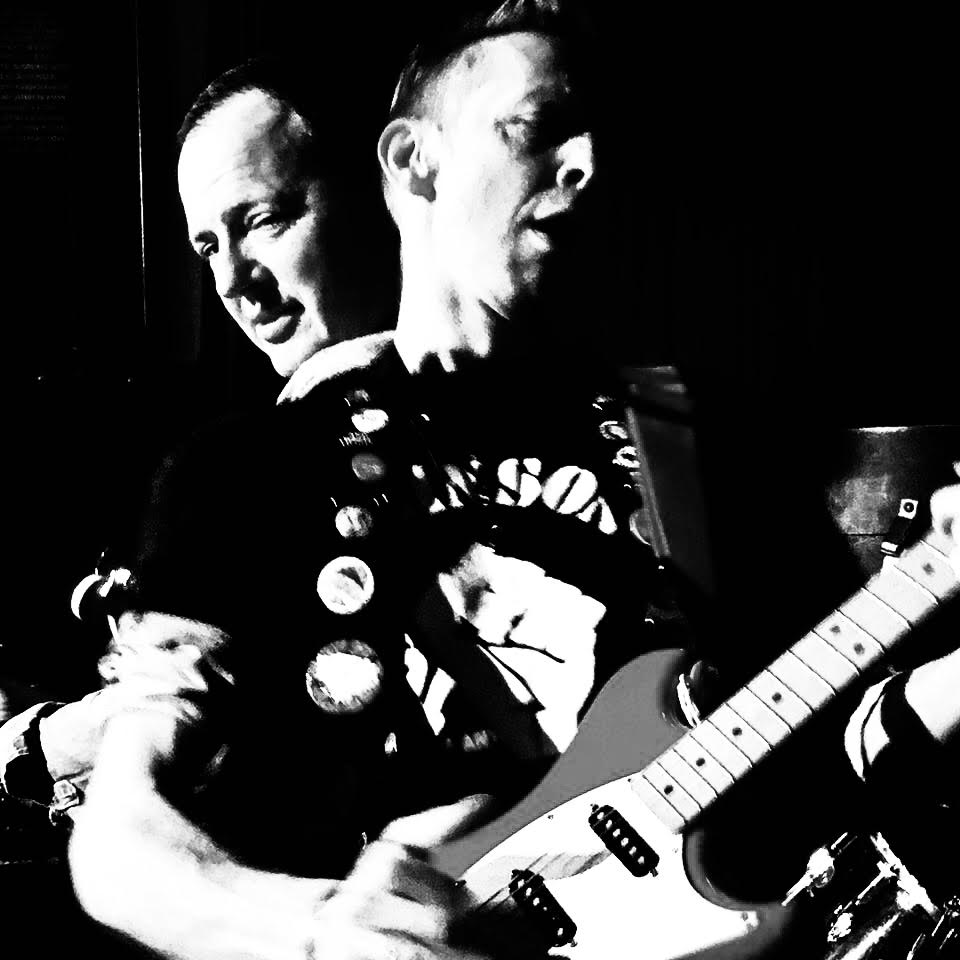
Mark Vennis and Different Place are Mark Vennis, Dave Sweetenham, Sean Quinn and Brian Gee.

“Fighting on all Fronts” was produced and recorded by Duncan LeFeuvre at Gravel Track Studios.